Category: Economics
A Tale of Three Crises
Conservatives like to pooh-pooh the US economy’s recovery from the worst downturn since the 1930s. But because the Great Recession is so singular, it’s difficult to judge recent economic performance, and the effectiveness of the government and Fed response. No downturn since World War II compares. Both for the conditions that triggered each, and their severity, the closest and nearest-in-time comparisons we have are the Great Depression and the Panic of 1893. And the US economy did much better this time around.
The Great Depression remains the worst of them all. GDP fell 30% and unemployment got to 25%. The Panic of 1893 saw GDP drop 5 to 10%, and unemployment peak at 12 to 18%. (Measures for that period remain crude.) The Great Recession was less severe: US GDP dropped 4.7% and unemployment topped out at 10%.
The key to our escape from what might have been a replay of the Great Depression was massive, directed spending on the part of the federal government, and perhaps more importantly, a commitment on the part of the Federal Reserve to pump cash into the economy, to prevent deflation. By one measure, US GDP in 2010 was 13% higher than it would have been in the absence of Fed and fiscal action.
It is not generally appreciated that the initial drop in economic activity during the 1st 3 quarters of the Great Recession during 2007-08 was in fact STEEPER than 1929-30. In other words, at the outset, the US was on track for a 1930s-style depression. The difference, according to the best research on the subject (cited below), was aggressive fiscal and monetary intervention.
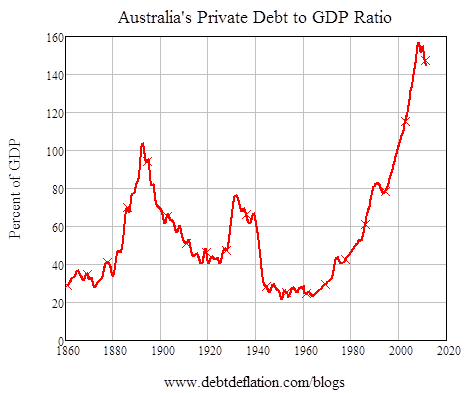
Financial bubbles happen when banks continue to pour money into an economy, even as asset prices inflate. When banks collectively get cold feet and stop lending, asset sellers quickly outnumber buyers, and prices collapse – as they do, a lot of money vanishes. It doesnt merely change hands – it ceases to exist – no longer available for borrowing, investing or buying. In 1893, the asset bubble was concentrated in railroads. In the Great Recession, it was housing. In the Great Depression, the bubble wasnt specific to a particular industry. In all three, the crash was preceded by a massive run-up in private-debt, followed by a prolonged economic malaise, in which banks were insolvent, and personal savings was wiped out – there was no money left in private hands to buy anything.
Getting out of such a funk takes time. With the Panic of 1893, real per capita GDP needed 6 yrs to get back to 1892 levels. And even after it did, unemployment (which lags behind other indicators) was 12% – the economy wouldnt get back to full employment until 1900, 7 yrs after the bubble burst. The Great Depression was worse: real per capita GDP didnt get back to its 1929 level until 1937, and full employment wasnt achieved until World War II.
By comparison, real per capita GDP after the GR needed 5 years to get back to its 2007 level. Full employment (which is not well defined) may be achieved next year, which would make for a 7 to 8 year recovery. Not quite 5 1/2 years since the GR began in Dec 2007, unemployment today is a manageable 6.7% (though labor force participation remains quite low). 5 1/2 years after the Panic of 1893 and Great Depression, unemployment was still in double-digits.
The relative shallowness of the Great Recession – both in unemployment and GDP contraction – can be directly attributed to a policy of deficit spending by the federal government, and aggressive action by the Fed to shore up banks and maintain money supply. The aim of these policies at the time was to take the edge off – and they succeeded. In 1893 and 1929, prices collapsed soon after asset values. During and after the GR, the US teetered on the edge of deflation but never succumbed – this alone may have halved the depth of the contraction.
The short of it is that financial crises dont make for ordinary recessions – the recovery that follows has always been slow, and is beset by persistent unemployment. But the US economy has come a long, long way since the dark days of 2008, thanks in large part to aggressive government and central bank action.
Refs:
Click to access End-of-Great-Recession.pdf
http://www.britannica.com/EBchecked/topic/243118/Great-Depression#toc234439
http://en.wikipedia.org/wiki/Panic_of_1893
http://en.wikipedia.org/wiki/Great_Recession
great source for historical macro data: http://www.measuringworth.com/
help wanted: i’d be very grateful for a historical graph on private debt for the US that looks like this one for Australia: http://www.creditwritedowns.com/wp-content/uploads/2011/11/Australia-private-debt-to-GDP.png
http://www.multpl.com/unemployment/table
Inequality: the Source and the Cure
Inequality begins with poverty, and is perpetuated by underinvestment in education, health and social insurance. One in four American children are born into a poverty that’s deeper and harder to escape than poverty in other western countries. They arrive to public school at age five or six as damaged goods – one can hardly expect any public school system to reverse the harm done, no matter the budget. The US spends a lot on education – but like healthcare, education spending is tilted toward the heroic, not the fundamental: America is the land of elite $50k/year universities – and of failing elementaries and high schools.
Top universities like Harvard operate like modeling agencies: they only want you if you’re pretty. By comparison, the Marines Corps believes that it can take anyone and turn him/her into a Marine. Americans so thoroughly accept the distinct roles of public and elite schools, that they hardly give it a thought. The best American universities – public and private both – run like modeling agencies, admitting only the best of the best, and rejecting the rest. But at the same time Americans expect their public elementaries and high schools to function like the Marine Corps, and turn out disciplined, literate and numerate young people, no matter their circumstances when they enter.
We already know that poor children are different from other children in real, observable ways. Being in poverty as a child has long-lasting negative health and income effects, and the differences even show up in brain scans. Poor kids arrive to kindergarten with all-but insurmountable deficits. If public schools are to be effective, they have to take kids at a younger age. By beginning public school at age three or four – adding pre-K, and even pre-pre-K – and guaranteeing at least 2 quality meals per day, 5 days per week over what should be a 200 day school year – the public will have the opportunity to invest in all of our children at a critical, formative age, so that when they get to kindergarten, they arrive ready to learn.
Head Start, America’s most famous pre-K program, has had fantastic results. When Head Start kids become young adults, they are more likely to finish high school, begin college and go to work – and less likely to become teen parents. They’re also healthier. This should be the model for a nationwide public pre-K system – this is how America can escape its cycle of poverty and inequality. By giving every child the means to reach their full potential, America can live up to its meritocratic ideals. Its self-image notwithstanding, America today is the least meritocratic country in the West. An American child’s destiny lies not in his talents, but in the circumstances of his birth. This isnt surprising, given the vast disparity in health and education resources available to different American children, depending on who they were born to, not on their innate talents.
While investing in public pre-K now, the US should follow up with free public community colleges at the other end. It is an embarrassment that America’s only federal universities are military schools. The federal government might lead by example and create a federal college system that’s free to anyone who passes an entrance exam. The exam can itself be a tool for maintaining high school standards. Alternatively/additionally the federal government could provide aid and offsets to reduce the cost of locally-based tertiary education to zero.
For decades, each successive American generation had far more education than generations past. But that trend ended abruptly around 1970, after which American education-levels flat-lined, and inequality exploded. Jump-starting growth in American education – both at the front and back end – is the key to future prosperity, to break America out of its funk.
Worked to the Bone II
We left off asking why it is that Americans put in so many hours compared to workers in other rich countries. The short answer is: it aint the American work ethic – it’s backward American labor laws. And ironically, one consequence of forcing workers to work so much – is that fewer working-age Americans actually choose to work, compared to workers in many other rich countries.
Unlike EVERY other rich country in the world – and many poor ones too – the US guarantees to full-time workers ZERO paid vacation days. Sort of astonishing when you take a step back to look at the numbers: legally required vacay in most western European countries is 4-7 weeks. In the US: 0. How about paid holidays? In Europe, typically about 10 paid holidays per year. In the US: 0 again. In many rich countries, workers, by law, get 30-40 paid days off per year. In the US: 0.
Next there’s paid parental leave. The US is one of 4 countries that do not offer it – the other 3 are Lesotho, Swaziland and Papua New Guinea. The typical benefit in rich countries is 3-4 months of paid leave – often at full pay. In America: 0.
The difference between the US and the rest of the world is legislation – American labor laws have not been updated since the 19th century. Even when Americans are fortunate enough to have paid vacation, they’re often unable to take it, for fear of sending the “wrong signal” to employers – that they’re not workaholicky enough. To cure this problem, many countries not only require paid vacation, but they require that it be taken.
Left to free markets, workers will never get much time off. The average American full time worker only takes 16 paid vacation days – less than the statutory minimum in practically every rich country.
Conservatives tend to be selectively stupid when it comes to free markets – even something so basic as supply and demand. When work becomes more valuable – when it comes with benefits like unemployment insurance, paid vacation time and maternity leave – more people want to work. This goes a long way toward explaining why labor force participation rates (LFPR) – the fraction of working age people actually at work – tend to be higher in northern European countries that have progressive labor laws. Switzerland, Sweden, Denmark and Norway are tops in LFPR, with rates of 78-83%. Germany, UK, NZ and Canada – all of whom have paid parental leave and mandatory paid vacation time – are close behind at 77% AND RISING. The US is down at 73%… and dropping. Labor laws in the US suck – Americans have responded by staying out of the work force, compared to people in other countries. Yet another workplace reality that Ayn Rand and her disciples failed to incorporate into their joke of an economic model.
Looking at unemployment rates, the US also compares badly with countries with far more generous unemployment benefits. Unemployment insurance is part of labor compensation – thus more UI means more compensation, which means more people will want to work. Only a conservative can pretend to not to grasp so simple a relationship. According to Forbes, the countries with the cushiest unemployment benefits ALL have less unemployment than the US: Sweden, Finland, Germany, Israel, Norway, Japan.
Conservatives fantasize about a Europe with progressive labor laws and widespread unemployment – people hangin’ out and collectin’ welfare. Reality is the opposite: Europe has proportionately more working-age people at work than the US. The difference between liberal and conservative views on employment law is that liberal views are legitimate theories, grounded in reality. Conservative blather persists in a factual vacuum – they are not theories, but dogmas – accepted on faith without evidence. And as with all matters of faith, they are not amenable to fact or logic. Europe has an exceedingly generous welfare state – and people are therefore MORE likely to go to work.
Being fundamentally without principle, conservatives can take any stand on any issue. A party that pretends on Monday to be pro-family should be expected on Tuesday to push for paid maternity leave. But conservatives instead reserve Tuesdays for yet more vapid sermons on small government and less regulation – which translates into: sorry, mom – get back to work – just like they do in Lesotho and Swaziland. So maybe it’s not a coincidence that an American baby is twice as likely to die in its 1st year compared to babies born in other western countries – but dead babies arent factored into conservative “pro-family” ideology – no more than motherhood.
Refs:
http://en.wikipedia.org/wiki/List_of_statutory_minimum_employment_leave_by_country
http://en.wikipedia.org/wiki/Parental_leave
http://www.huffingtonpost.com/2013/02/04/maternity-leave-paid-parental-leave-_n_2617284.html
http://www.huffingtonpost.ca/2012/05/22/maternity-leaves-around-the-world_n_1536120.html
http://stats.oecd.org/Index.aspx?DatasetCode=LFS_SEXAGE_I_R#
Worked To the Bone I
Conservatives did their usual thing with a recent CBO report on the ACA – the real dumb ones didnt understand it and said a bunch of stupid stuff. The dishonest ones – who’ve long appreciated the benefits of saying stupid stuff to a base only too happy to hear it – did the same. The press dutifully reported their inanity as “viewpoints” if not “information.”
After 48 hours spent spewing the lie that the ACA will cost 2 million jobs, things have cooled down – but the typical dim conservative has now stored it as “fact”. We’ll surely hear the lie repeated right on through the 2016 election – because that’s the way it goes in conservative politics. The dumber your constituency, the freer you are to say what you like, no matter the facts.
The reality behind the CBO report is that the ACA has given workers more options. No jobs are going to be eliminated because of new ACA benefits, but rather, as CBO says explicitly, workers are expected to CHOOSE to work fewer hours – as a matter of personal preference. People arent getting fired or seeing their hours reduced. The new law simply provides workers with new opportunities – to work less to care for children or elderly parents – or simply to take some personal time – without worrying about losing their health insurance. Economists pass no judgment on your desire to work more or less – any more than they’d judge your choice of ice cream flavors – it’s a matter of pure preference – de gustibus non est disputandum.
But the entire episode passed without pundits seizing on this fundamental fact: Americans work far more hours than people in other rich countries. Compared to the 1790 hours worked by the average American full-time worker per year, the average Canadian works 1710; the average Brit: 1650; the average Dane: 1550; and the average German: 1400!
For fear of perpetuating the stereotype of the lazy, party-crazy German, and the sober, hard-working Mexican, I hesitate to mention that, within OECD, Mexicans work by far the most hours (2200) – 55% more than Germans. The EU conflict between Greece and Germany could be attributable to cultural differences: hard-working Greeks put in 40% more hours than indolent Germans – more than 2000 hours per year.
But America’s not losing its nose-to-the-grindstone edge anytime soon – CBO says that total hours worked by already worked-to-the-bone Americans will still increase over the coming decade – only that the increase will be smaller than it would have been in the absence of the ACA. How much smaller? 2%, tops. Given that Americans are already working 5% more than Canadians, 10% more than Brits and 35% more than Germans, this cannot possibly be a serious concern. For the average American worker, less is more – especially when it’s the worker who’s making the decision to work a little bit less. Conservatives are all about personal choice – except when it concerns real people making real life choices. After all, what’s liberty without the freedom to be a slave?
Pondering these numbers, one might grow curious as to why Americans put in so many hours compared to workers in other rich countries. Is it a superior work ethic? Not nearly. Tune in Friday when we investigate the source of long American hours.
Note: The Field Guide, effective this week, will have new material every Monday, Wednesday and Friday, with the possible threat of Bonus Material on weekends. Yes it’s true that Krugman only does 2 columns per week – but CT loses far less time dodging undergrads and trimming his beard….
Refs:
http://www.cbo.gov/publication/45096
http://www.latimes.com/business/hiltzik/la-fi-mh-cbo-20140204,0,3106578.story#axzz2tWReHhfk
http://www.huffingtonpost.com/bob-semro/affordable-care-act-a-job_b_4741300.html
Minimum Wage
Raise the price of something – we all intuit – and people will want less of it. Raise the minimum wage and low-wage employment will decrease. Great theory – cryin’ shame the facts dont support it.
If you could raise the minimum wage and hold all else constant, it’s hard to imagine that employment wouldnt be adversely affected. But you cant. People working minimum wage jobs are poor. Poor people are fairly predictable in this regard: give them extra cash, and sure enough, they go and spend it. So when you increase the minimum wage, you should expect to get a commensurate bump up in consumer demand.
Tax cuts for cagillionaires, by comparison, have less predictable effects. When so-called “job-creators” get a tax break, the extra cash rarely goes into consumption. You can only drive one Maserati or sleep till noon in one ski chalet at a time. Their extra income tends to go to saving/investing – and since capital is free to cross borders in search of the best return, tax cuts for the rich are as likely to create jobs in Thailand or Mexico as anyplace else.
On the other hand, when you give a McWorker a raise, the extra cash is not likely to go into a Roth IRA. It will almost certainly be spent locally – at Walmart, the supermarket, the dentist, Jiffy Lube, etc. And guess what: the cumulative effect of raising the income of ALL minimum wage workers at the same time MORE THAN offsets the increased labor costs. Employers experience an immediate bump-up in demand, and so not only do they maintain employment levels – if anything, they add jobs. The charm of this theory is that it’s actually borne out by the facts.
Twenty years ago, this effect was only suspected – it at best constituted a minority opinion among economists. Then two yet-unknown, up-n-coming economists seized on a change in state law as a “natural experiment.” New Jersey raised its minimum wage; neighboring Pennsylvania did not. David Card and Alan Krueger looked at the border area to see if employment in the two states diverged – they found that it didnt.
With increasingly sophisticated methods, Card and Krueger and other researchers have since reproduced these same results many times over: when you increase the minimum wage, low wage workers do in fact experience an increase in income (that is, their employers dont cut their hours in response); and employment holds steady. This effect has become common knowledge among economists – not that conservatives care – their beliefs arent based in fact anyway – they’re happy hanging on to refuted, sophomoric theories – if they cant wrap their brains around evolution, what chance could they have to grasp economics?
Minimum wage is a classic case in which free markets can NOT be relied on to produce optimal results. If an individual firm chooses to increase wages, it’s not likely to experience an offsetting increase in demand – it will probably cost the firm. However if everyone increases wages at once, everyone comes out ahead: the nation’s poorest employees get a raise that costs their employers nothing. It’s a textbook case for using legislation to improve wellbeing when free markets cant do the job.
In constant dollars, today’s $7.25 minimum wage is lower than it was during the entire 30 year period 1955-85. With American poverty at its highest in decades – the highest of any rich country – and with its poorest workers increasingly unable to keep up, raising the minimum wage is sound, sensible policy at a critical time.
Refs:
http://economix.blogs.nytimes.com/2010/11/01/along-the-minimum-wage-battle-front/?_r=3
http://www.nber.org/papers/w4509
Why Big Govt Works – Part 3
Before the 20th century, government didnt do a whole lot – but there wasnt much a government could do. The fact that private markets dont do a very good job providing healthcare and education wasnt so big a deal then: the return on investment for education was low, so no big opportunity was being missed. And since human capital stocks were also much lower, there was no big bang in investing in healthcare either – not that 19th century medicine offered much. (The gains in life expectancy during the 19th century are more attributable to improved sanitation.)
Come the 20th century, things changed. The returns to education took off – people who stayed in school enjoyed big increases in income – and as incomes rose, people became more valuable, and sickness and death became far more costly – and thus medical care became cost-effective. After WW2, every country which would become rich struck on this same formula: heavy taxation and commensurately heavy public investment in health and education.
In 1950, even the Western countries who made it through WW2 with their infrastructure intact werent particularly wealthy. Australia, Canada, Sweden and Denmark – then ranked 5,6,7 and 8 in per capita GDP – had similar incomes to present-day Botswana, Bulgaria, Peru and Turkmenistan. Fast forward to today, and we see that under their big governments, those western countries grew their per capita GDP by a factor of 10. The US, with its much smaller govt, only saw per capita GDP increase by a factor of 5.
Beyond health and education, social insurance is the budget item that rich governments spend the most on. While a typical western government spends about 5% of GDP on education and 10% of GDP on health care, it spends 10 to 20% of GDP on social insurance – excluding health insurance. As seen in yesterday’s post, insurance markets are beset by difficulties of adverse selection and asymmetric information. The solution – for insurance markets to provide a valuable service – has been heavy government regulation, if not wholesale direct government provision, as is commonly the case with social insurance.
When conservatives whine and cry about social insurance, they make generic arguments that are equally applicable against ALL forms of insurance. Typical conservative blather in opposition to unemployment insurance and welfare, e.g., is indistinguishable from opposition to every other form of insurance. If UI is bad because it lets people be rude to their boss and picky about their next job; then auto insurance is bad because is facilitates riskier driving; and homeowners’ insurance is bad because it encourages people to use their fireplace more (while cleaning their chimney less); and health insurance is bad because it makes people more likely to ski; and bailouts are bad because they make banks more likely to undertake risky investing; and of course old age insurance (aka “social security”) is bad because it lets you save less for retirement – etc., etc. What these arguments have in common is that they are all fundamentally TRUE.
Acquiring insurance changes your behavior – this is referred to as “the moral hazard problem.” Obtaining insurance to cover yourself in case of a particular loss often alters your behavior in such a way as to make that loss more likely. In other words, insured people behave worse than uninsured people. – But not that much worse – and that’s the key insight. In order to obtain an insurance benefit, you generally have to incur a loss – losses are unpleasant, and insurance rarely covers the full cost. People dont like losing their job or crashing their car – and the stats bear this out.
Unemployment isnt any higher in places where benefits are cushy. In Europe, a generous welfare state is accompanied by high labor force participation and low poverty. Further, generous welfare doesnt bust budgets: the government debt in most western European countries is lower than that of the US. In Scandinavia – where social insurance is most generous – government debt is half that of the US.
If you complained to friends that your car insurance was a rotten investment because you hadnt had a wreck or severely injured someone – they might think you were loopy. Complaining that Social Security is a “bad investment” is no less silly. Social Security is an INSURANCE program, not a mutual fund – it helps to call it by its more precise name: old age and survivors’ insurance. As with most forms of insurance, the way to come out ahead is (usually) to suffer a really bad loss. You can do quite well with your social security “investment” by dying young and leaving behind a family to collect, or by becoming disabled, or by outliving your savings. In the way that life insurance takes care of your family in case you die, old age insurance takes care of you in case you dont – or your family in case you do. Sheer genius.
Unlike health and education, the relationship between public spending on social insurance and economic growth is one of the most complex and subtle areas of economics. One theory is that generous social insurance subsidizes risk-taking – people are more likely to gamble on career choices with a reliable safety net – and in the aggregate, taking risks grows the economy. Another theory is that by taking care of old people through old age insurance, their children have more to invest in themselves and their own children. Another theory is that, by reducing poverty, social insurance ensures that children are able to realize their full potential. Child poverty is associated with inferior outcomes later in life in every dimension. Adults who began life in poverty tend to have shorter lives, lower incomes, reduced employment and higher crime rates.
WIth its weaker social insurance regimes, the US child-poverty rate is over 20% – the highest in the developed world. Hungary and the Czech Rep., with just one-third of US income, have half the child poverty. The US has a higher child-poverty rate than Latvia, Estonia, Greece or Portugal! The US doesnt just have the MOST child poverty in the west – it also has the WORST. Unicef found that American poor kids were much further below the poverty line than poor kids in other countries.
And while the US has more poverty than any western country, it also has less social mobility: kids born into American poverty are far less likely to escape than kids born into poverty elsewhere. In America, the income strata you’re born into is much more predictive of where you end up. Indeed, the American dream has packed up and returned to the old country….
Conservatives would have you believe that a smaller government is better for economic growth – but that view is utterly at odds with the facts. Countries that spent generously on health, education and social insurance since WW2 experienced the best economic growth ever seen in human history. While the US spent a lot on education, it remains the only developed country without universal health insurance, and still tries to get by on minimal social insurance – American growth has suffered as a consequence. Before the industrial revolution and the explosion of technology, individual human beings had much less potential. There has never been so much knowledge and skill to acquire, nor better medical care to remain healthy – and the only way to take advantage of these opportunities and maximize growth is through public investment: in health, education and social insurance. It takes a big government to accomplish all that – but in the end, we’re all richer for it.
Refs:
http://www.nationmaster.com/graph/eco_gdp_per_cap_in_195-economy-gdp-per-capita-1950
http://en.wikipedia.org/wiki/List_of_countries_by_GDP_%28nominal%29_per_capita
http://www.ncbi.nlm.nih.gov/books/NBK62373/
http://en.wikipedia.org/wiki/Social_insurance
http://www.nationmaster.com/graph/eco_soc_sec_exp_as_of_gdp-economy-social-security-expenditure-gdp
http://en.wikipedia.org/wiki/Child_poverty#Developed_countries
http://www.nationmaster.com/graph/eco_chi_pov-economy-child-poverty
Why Big Govt Works – Part 2
The reason why big government works in the area of healthcare is the same as why it works for education. These are both vital areas that are poorly served by private markets. And those private markets will fail the larger economy by not creating and sustaining enough human capital, upon which our modern economies are based.
Free markets are a many-splendored thing – but they’re not perfect, and many of their flaws are well known. The private market for healthcare is a textbook case of failure – privately-provided healthcare is relatively costly and ineffective.
Our jumping-off point is the recognition that the typical European spends about half what the typical American spends on healthcare – and enjoys much better health. The typical European government picks up about 75 to 85% of the nation’s health tab – while the US government only pays about 45%. Remarkably, because their costs are so much lower, a European government’s 85% share amounts to less money than the US government’s 45% share! That’s right folks: the US government is already spending more on healthcare, per person, than most European governments. (So who’s the real socialist here?)
What specifically causes the market for healthcare to break down? For starters, while your doctor understands your condition better than you do, he has a natural conflict of interests: while you want health, he wants to get paid – and so doctors tend to create a demand for services that pay better. This is really bad for your insurer – who likely knows less about your condition than either you or your doctor – because he gets stuck with the bill (unless he can wriggle out of it). The end result is doctors billing insurers for services of questionable value, and patients not knowing better than to go along for the ride.
If you dont like your doctor, sad to say but here in the US we have far fewer primary care physicians than in most other countries. You can largely thank the AMA, which has been in the business of NOT accrediting new med schools, and lobbying against licensing foreign doctors for decades. If you dont like your hospital, it may be tough finding another place to get treated – in many parts of the developed world, patients dont have much local choice for providers. Private insurers in many US regional markets are often stuck with a single hospital, and thus cant negotiate lower prices.
Externalities problems in healthcare are much worse in the developing world, where infectious disease is much more common. (Your flu shot, e.g., is of greater cumulative benefit to the 3 people who dont get the flu as a consequence, than it is to you personally. But they didnt pay for the shot – you did.)
When it comes time to obtain health insurance, the grand-daddy of all market problems rears its head: adverse selection. Its seminal description came in a 1970 paper, “The Market for Lemons” – which explains the difficulty of finding a decent used car. (Its authors won the Nobel Prize.) Here’s how it goes: the seller has better information on a car’s quality than the buyer – because of the risk of buying a lemon, the buyer rationally reduces his offer price. Lower prices make the market less attractive for sellers of good used cars – and so the quality of the average used car drops – which forces buyers to lower their offer-price even more – which drives even more good cars out of the market (so to speak). The cycle continues until you’re left with a market for lemons.
This is precisely how health-insurance markets fail. Before the ACA, people could choose to be insured or not. The worse your health, the more likely you’d find health insurance to be a good deal. Recognizing this, insurers would raise their premiums. As premiums went up, healthy people were less likely to buy insurance. As the risk pool got more sickly, insurers would raise premiums more… and so on and so on – until insurance was no longer cost-effective for anyone. We all may want to buy used cars and health insurance – but because of asymmetric information and adverse selection, the market fails to provide.
If you were gonna custom-tailor a market to misbehave, healthcare would be a good blueprint to follow. The good news is that all of these problems have solutions – this is why western Europeans enjoy the best health and the best healthcare in the world, and dont go broke paying for it.
The cure for a provider monopoly is a public-payer monopsony. Even in the US, it’s well known that Medicare – the government insurer – has lower costs than private insurers. One significant reason is that Medicare is a monopsony healthcare buyer for the over-65 population. Given that over-65s are the beneficiaries of a huge fraction of total health expenditures – providers are forced to play ball with Medicare.
The market-for-lemons problem with health insurance is fixed by making everyone participate in the insurance pool – which is a large part of the ACA. Since not everyone can afford insurance, the government has to subsidize it too.
Regulatory changes can better align the interests of doctors, patients and insurers. David Cutler has an excellent article (cited below) detailing some of the new cost-controlling rules in the ACA. The really, really good news is that during the 3 years since the ACA passed, the growth of US per-person healthcare costs has slowed to the lowest rate ever recorded.
The cure for what ails healthcare is well known, and has been in practice in many rich countries for decades, with excellent results. And now it’s coming to the US, which is the best news of all.
Tomorrow, the dramatic conclusion of why big government works, when we take up the big, big money in social insurance –
Refs:
http://en.wikipedia.org/wiki/Health_care_compared#International_comparisons
http://en.wikipedia.org/wiki/The_Market_for_Lemons
http://en.wikipedia.org/wiki/Health_care_in_the_United_States#Spending
Why Big Govt Works
In previous posts, we’ve seen that every rich country in the world has one thing in common: a really, really big government. And some of the richest countries in the world have the biggest governments. Up till about 1900, governments generally taxed and spent less than 10% of GDP – US government spending in 1900 was about 7% of GDP. But today the world’s richest countries tax and spend 30 to 55% of GDP – the few who spend less instead have major ownership and-or controlling interests in firms and banks. What’s more: those rich countries only became rich AFTER their big governments were in place. The flipside is that every country today that’s gone small – is poor. This plainly contradicts the conservative dogma that large government is inimical to economic growth – but the essence of dogma is that it doesnt require facts to persist, and actually does quite well in a factual vacuum.
According to a very simple economic model, there’s no way that an economy should be able to grow – much less grow well – with its government sucking up 40 to 50% of all the value created, and distributing it according to political decision-making. The free market is far better at allocating resources to fetch the highest return. In a perfect market, whoever wants something the most – and has the means to obtain it – will obtain it – by paying a higher price for it than others. Markets work by aggregating the wants and needs of many individuals – they dont have to meet and chat, they dont even have to know each other – they simply express their preferences by buying and selling at what emerges as the market price.
In order for countries to grow fast with a big government making large-scale resource-allocation decisions in place of the market, that government’s decisions have to be pretty good – as good as the market, if not better. Again, according to conservative dogma and very simple economic models, government just cant do it. But the facts say otherwise. And so do the theories.
It helps to start by looking at what those big government are lavishing all those sums on. In 1900, governments didnt do a whole lot: roads, security, the post office, elementary schools. All tolled, it didnt add up to much, and it still doesnt. The extra spending that’s been added on top falls generally into 3 major categories: education, healthcare and insurance.
Education has become a big-ticket item in the developed world. A typical rich country’s government spends about 5% of GDP on education – about the same as what the US spends each year on social security (the largest single item in the federal budget). Public education itself has moved beyond debate – not even conservatives question the value of taxing and spending for education (though they’ll question the form that that spending should take – to voucher or not to voucher, eg).
But it’s fair to ask WHY governments should be involved in education at all – why cant it be left to the markets? What makes the market for education different from the market for plasma TVs, pet grooming or accountancy? The primary obstacles are access to capital and externalities. A 6 yr old cant walk into a bank and take out a loan to pay for his education, using his future income as collateral. Even if he could, much of the benefit of his education goes to other people – education facilitates better decisions (in the voting booth, eg), and raises income, allowing him to spend more (which becomes other peoples’ income) and pay more in taxes. Education reduces social ills too.
When you dont enjoy the full benefit of a given action, you’re less likely to do it as much. If, as in education, the buyer (or investor) got the full benefit of his expenditure (or investment), there might be no need for public education. But since he doesnt, the government has to step in take up the slack.
Education can be thought of as the process by which we create human capital – and human capital is precisely the thing that makes a rich country rich. We might do a thought experiment: take 2 rich countries – let’s say Japan and Germany – and imagine what would happen if they were bombed back to the stone age – factories, buildings, bridges, roads, housing – imagine that every physical structure was annihilated. I’d wager than within a generation, they would be rich countries again. (!) The reason is that the wealth of a rich country is NOT in physical structures, nor is it in private equities or real estate, nor is it in the ground in mineral wealth – it’s in human capital.
If education is the process by which human capital is created, healthcare is what sustains it. Sick people are not productive – and when we die, our human capital dies with us. In the 19th century, even the most productive countries in the world werent terribly productive. US per capita GDP in 1900 was about the same as Paraguay’s today. In 1928, the US was only about as productive as present-day Botswana. When people got sick – not that medical care of the time could do much – it simply would not have been cost-effective to spend a lot to heal them. What’s different today is that the average resident of a developed country has an enormous stockpile of human capital. Human capital can be crudely calculated as the present (discounted) value of all future income – so a person who will make $50k/yr for 20 more years has human capital worth $1 million (before discounting).
In developed countries, middle-age people with average incomes commonly have human capital of well more than $1 million – and this is the reason why, as countries grow richer, it’s profitable to spend more and more on healthcare. (The fact that we spend a fortune on old people’s healthcare – despite their reduced human capital – will be the subject of another day’s meditation.) But why, we should ask, cant we leave healthcare to the private market? Even in the US – with the most privately-financed healthcare in the developed world – the government’s share of healthcare spending is about 45% – about 8% of GDP.
To be continued tomorrow: why the countries whose governments went heavy investing in health and social insurance cleaned up….
PS: Did anyone else notice on the Daily Show last night – John Stewart sharing a pizza with utensil-wielding NYC mayor Bill de Blasio – that Stewart fails to correctly FOLD his slice? Such is ever the case when Jersey boys impersonate real NYers – they can only sustain their farce for so long….
Refs:
http://en.wikipedia.org/wiki/List_of_countries_by_spending_on_education_%28%25_of_GDP%29
http://www.usgovernmentspending.com/education_spending
Socialism? Yes, please!
Over the past 65 years, the US and western Europe have followed different social models. While the US government expanded during the Great Depression and WW2, it remained much smaller than western European governments, which provided universal healthcare, more comprehensive social insurance, and even owned and controlled numerous banks and firms. US government spending has been about 30 to 35% of GDP over that time – while in Europe it’s more typically been 40 to 50%.
Conservative dogma has it that large government is inimical to economic growth. It would seem that we have a fine natural experiment: we can judge western European-style socialism by comparing their economic growth with that of the US.
According to the Bureau of Labor Statistics (BLS), the US is at the bottom of the pack with respect to GDP growth per capita for most of the past 65 years. European countries following socialist models – with large public investment in health, education and insurance – grew more. The US isnt just outperformed by France, Germany and Italy – countries who suffered the most war damage – it’s outperformed by every country except Australia. It’s true that the countries that escaped the brunt of the war are clustered at the bottom for growth – but the US is at the bottom of the bottom. This isnt just the case for per capita GDP since 1950 – the pattern holds for growth since 1960, 1970, 1980 and 1990 as well. European growth only stumbles in the mid 90s with the rise of the EU – when Europe sought to privatize industry and control spending – i.e., when they started emulating American policies! Strike one for conservatives: socialism, for economic growth, looks pretty good.
Socialism – as Americans are taught from infancy – saps the work ethic, bloats public debt, and makes a population lazy and dependent. If conservative theories are correct, when we look at Europe we should see high unemployment and deficits as far as the eye can see.
Forbes did a nice piece a few years back, searching the world over for the cushiest countries to be unemployed. The winners were Denmark, Norway, Finland, Sweden, Israel, Japan and Germany. According to Forbes, Norwegians “receive 87.6% of their previous salaries for 500 days.” Fins “receive 85.1% of their previous salaries for one year.” In the other countries, benefits are “between 66% and 90% of their last salaries.” Meanwhile in some US states, benefits “are as low 27%” for people of average income.
So you gotta imagine that workers in those countries are lounging around, taking it easy, drinking in pubs and watching soccer at the public’s expense. You imagine wrong. Unemployment in all of those countries is the same or lower than it is in the US. And Labor Force Participation Rates (LFPR) – the fraction of people aged 15-64 in the workforce – is in fact MUCH higher in all of those countries (except Israel). The US LFPR is about 73% – in most of Scandinavia it’s closer 80%.
You’d also expect, as we’ve been told, that those socialist economies are collapsing under mountains of debt, from their unsustainable social welfare programs. But except for Japan, all of those countries have less debt than the US. Scandinavians, with the largest governments and the most generous social programs, are the least indebted – the government debt of Sweden and Denmark is HALF that of the US (50% of GDP vs. 105%). In Norway it’s about one-third. The gap between conservative myth and real-world fact is large enough to swallow a whole continent.
Following WW2, there was a wide chasm between the US economy, and that of most of Europe – their infrastructure was wrecked, ours was built up – millions of their working age citizens were slaughtered or displaced. In 1950, per capita US GDP was tops in the world by a wide margin – almost 10% greater than #2 Switzerland, almost 15% greater than #3 New Zealand – double that of #14 Germany. The top 8 eight countries in 1950, not coincidentally, were all spared the brunt of the war’s destruction.
65 years of socialism – or its lack – have left its mark on western economies the world over. US per capita GDP has now been exceeded by countries that taxed more heavily and invested the proceeds in the health and wellbeing of its population. In 1950, US per capita GDP was about 40% greater than that of Canada, Australia, Sweden and Denmark – today, it is smaller.
But things are even worse. American per capita GDP is inflated by Americans working far many more hours than their European counterparts. The US is the only advanced country in which full-time workers are guaranteed ZERO paid leave. While Americans are producing less than many other now-richer countries, they are working more too. The average American worker puts in about 1800 hours per year. Canadians and Aussies put in closer to 1700; Scandinavians toil for 1600; and Germans – those teutonic lazyheads – dont even squeaking out 1400!
More hours and less output? How could it be worse!? But it is worse! As one may accurately observe: the “average” human being has one breast and one testicle – since America has far greater inequality than any of those countries, “average” income is far less meaningful for Americans, since few of them fall at or near the average. America has much higher poverty than any of those countries – 17% as measured by OECD – double that of almost every country named above.
In an effort to understand just how well (or badly) the people in a given country are really doing, economists developed a new metric: the Human Development Index – or HDI. (One of its developers, Amartya Sen, got a Nobel Prize for his work on human welfare.) HDI encompasses life expectancy, education and income, and then adjusts for inequality. The US now ranks 16th.
Americans have been sold a rotten bill of goods. As discussed in a previous post, several key industries are not well served by free markets – rich, modern economies need the government to ensure adequate investment in health, education and insurance. The conservative preoccupation with smaller government persists in a factual vacuum – ignorant to the fact that the world’s most prosperous nations – which enjoy high productivity and high workforce participation, as well as broadly shared wealth and good health – all have much larger governments than the US. Generous social insurance – far from leading to sloth and dependence – has made Europe healthy, productive and meritocratic. Indeed, the American dream has emigrated back to the old country – America’s poor are far more trapped in poverty than their European counterparts.
“Socialism” has become the right’s latest pejorative for the left – following in the tradition of “card-carrying liberal”. With its truth revealed and mythology debunked, liberals should wear it as a badge of honor.
Refs:
Wealth/Production:
http://www.bls.gov/fls/intl_gdp_capita_gdp_hour.xls
http://en.wikipedia.org/wiki/Human_Development_Index#Inequality-adjusted_HDI
http://www.nationmaster.com/graph/eco_gdp_per_cap_in_195-economy-gdp-per-capita-1950
http://en.wikipedia.org/wiki/Median_household_income#International_statistics
http://en.wikipedia.org/wiki/List_of_countries_by_GDP_%28nominal%29_per_capita
http://stats.oecd.org/Index.aspx?DataSetCode=IDD
Debt:
http://en.wikipedia.org/wiki/List_of_countries_by_public_debt#List
Labor:
http://stats.oecd.org/Index.aspx?DatasetCode=LFS_SEXAGE_I_R#
http://stats.oecd.org/Index.aspx?DataSetCode=ANHRS
Spending:
http://www.usgovernmentspending.com/us_20th_century_chart.html
Homage:
http://www.scientificamerican.com/article/the-social-welfare-state/
Gun Economics
It was another splendid morning in America – as folks woke up to the news that yet another child had gloriously sacrificed her 9 year old life for other peoples’ enjoyment of their 2nd Am. rt to keep and bear arms. Gabby Giffords took time out of her busy skeet-shooting and armadillo-hunting schedule to advocate for more stringent background checks. Surely, Madison wd weep for joy at all his law had engendered….
There’s a stark asymmetry: that the people who ENJOY the right to keep and bear arms are rarely the same people who PAY the cost of their enjoyment. And so I began a-wondering: would gun mfrs., sellers, buyers and owners make different decisions if they had to absorb the full cost of their actions? At the extreme, one might have a law that prescribed the death penalty for a gun owner whose weapon caused the death of another person, no matter if he or someone else pulled the trigger. Yeah, that’ll never happen, but….
What if lawmakers (1) make the parties to gun transactions (mfr, buyer, seller, owner) strictly liable for all damages the gun causes; (2) and require the parties to obtain insurance to cover prospective losses.
Economically, the market for guns is rife with negative externalities that keep prices artificially low. Forcing market participants to absorb the full costs of their decisions will only improve market efficiency. Conservatives will love it, because, y’know, they’re all about free enterprise – and surely it will pain them to recognize that gun owners, effectively, are welfare moochers, leaving a tab for society to pick up.
An employed middle-income 40something with a clean record might pay a pittance to insure a shotgun or hunting rifle that’s kept in a safe. A gun shop owner will be happy to have him as a customer. But an unemployed 20something male might pay a small fortune to insure a 12-clip 9mm that he plans to keep alternately in his glove compartment and night stand. Shop owners, seeking to control their premiums, might be very careful about who they sell to. And of course, a careless shop owner might find himself unable to obtain affordable insurance. These are all positive effects.
The present interpretation of the 2nd am. is not likely to survive another Democratic presidential term. But even assuming that we have to operate within that stricture, it should be clear that the 2nd am. does NOT require that guns be free. Requiring that gun sellers and owners bear the full cost of their actions does NOT technically increase the cost of selling and owning guns – it simply reallocates the cost onto the parties themselves, and off of society.
 Carlton Thurman's Liberal Field Guide