Category: Law
Nation Squashed Under God
Another 5-4 decision, another step backward for American Civilization. In Greece v Galloway the Supreme Court’s 5 catholics conservatives decided it was no biggie if a town begins ALL of its monthly board meetings with a Christian prayer. Why didnt the town of Greece, New York start its meetings with other sorts of prayers? ‘Cause Those Other People (AKA Their Kind) dont live within the town limits, y’all.
But – you may be wondering – if some poor Jew or Muslim happened to attend, say, a DECADE’s worth of town meetings, to be subjected at EVERY occasion to references to spirits, jesuses, easter bunnies, crucifixes and archangels – they might get to thinking, WTF, this mother&%*#ing town went all medieval and established a religion! Not to worry, Anthony Kennedy reassures us. That sort of junk’s been goin’ down since way back in the day when the 1st amendment got written, and so therefore it’s a-ok today. Even if it’s awkward as hellfire to be a Hindu in upstate New York, Hindus just gotta roll with it – amen.
That may sound like idiocy masquerading as legal reasoning. So to be safe, Clarence Thomas attached a classic Thomasian concurrence that’s so batshit crazy, it makes Kennedy look like a transcendental poet by comparison. (Thomas has been lending Kennedy an illusory competence for years.) Having devoted his career to justifying prison beatings under the 8th amendment (not a joke), Thomas outdoes himself by asserting that the 1st amendment’s establishment clause does NOT protect an individual right, but rather protects the state’s right to establish a religion, free from the federal government’s meddling. (Scary – and still not a joke.) Thomas warms up with the deep thought that the establishment clause “probably prohibits Congress from establishing a national religion.” – Which is probably a relief. He goes on to complain that “applying the Clause against the States eliminates their right to establish a religion free from federal interference.”
Waiting for Jamie Farr to bang the gong and end the gag? Sorry, folks – It’s real. In Greece v. Galloway, the majority opinion, penned by Anthony Kennedy and now the law of the land, holds that it’s okay for a town to begin ALL of its meetings with a prayer from a single denomination – a prayer as colorful and-or grotesque to nonbelievers as you want, with Jesus-on-the-Cross, Mohammed-on-the-Virgin, Shiva-on-the-Rampage, etc – you couldnt overdo it if you wanted. And if you, Jane Q. Citizen, happen to be in attendance, and maybe feel a tad squirmy about whether to stand, kneel, bow your head, make the sign of the cross, sit in lotus, or turn to the east and touch your nose to the carpet – Kennedy says suck it up, cuz that’s life in (18th cent.) America, babes. If Clarence Thomas had his way, the state you live in could just as well establish Islam as the official religion, so if you dont like it, you can pack your sorry second-class citizen self and move to Canada or Holland or some other place with a real, functioning Bill of Rights.
Or, as Andy Borowitz put it, “In Landmark Decision, Supreme Court Strikes Down Main Reason Country Was Started.”
Refs:
Voter ID Laws Are the Fraud
Voter turnout in the US is abysmal, but predictably so. Turnout in winner-take-all style elections tends to be low across the world, because people are sensitive to the relative ineffectiveness of each marginal vote. When the difference between a 51 and 70% majority – or the difference between a 5 and 10% minority – actually affect the composition of the government, people respond and turn out in greater numbers.
Getting Americans to vote has for a long time been an uphill struggle – so it’s all the more troublesome when conservatives look for new ways to suppress turnout. One recent ploy are voter ID laws. While you and everyone you know probably has a driver’s license, passport, social security card and birth certificate, a fair number of the poor and old do not – and they’re especially burdened by having to obtain or replace such documents.
Voter ID laws arent like poll taxes – they are poll taxes: their imposition all but guarantees that a citizen will have to give money to a government agency, or be denied the right to vote. Even when ID cards are offered free of charge, documents needed to obtain them are not. And while $30 for transport and fees (a typical replacement cost) may not seem like much, it happens to be the average weekly Food Stamp benefit. For the elderly, the journey from the nursing home to the government office (or 2 or 3) may be a greater burden than the money. In either case, voter ID laws will cause legitimate voters to reasonably choose to not vote, simply because the cost is not justified by the benefit.
While there are several types of voter fraud, voter ID laws target just one kind – voter impersonation – which happens to be among the rarest. One DOJ study for the period 2002-05 found 26 convictions for voter impersonation – out of 197 million votes cast. That gives us a voter impersonation rate of .00000013. To get an idea of just how rare that is, the US in that same 2002-05 period had about 60,000 homicides. Put otherwise, the US voter impersonation rate per 100 million votes cast is 13 – while the US homicide rate per year per 100 million people is about 4800 – 370 times greater.
One look at the crime stats for voter impersonation, and the real purpose of voter ID laws becomes obvious. Their aim is to disenfranchise legitimate voters. And it’s no coincidence that practically every one of the 30+ states that have enacted some sort of voter ID law have done so with GOP legislatures and GOP governors. Voter ID laws dont prevent fraud – voter ID laws are themselves the fraud.
Refs:
http://abcnews.go.com/Politics/OTUS/voter-fraud-real-rare/story?id=17213376
http://abcnews.go.com/Politics/OTUS/voter-id-vote/story?id=17206253
https://www.aclu.org/voting-rights/oppose-voter-id-legislation-fact-sheet
Grin and Bear It
Few Americans know that the Bill of Rights was only written to protect them from the federal government – not their state government. A long line of US Supreme Court cases, going back to 1833, clarifies why. The Constitution created a new federal government; and the first 10 amendments to the Constitution limited that new federal power, but not the power of states. For 150 years after the nation’s founding, individual states could deny to its citizens any and all rights in the Bill of Rights: speech, religion, privacy, jury requirements, self-incrimination, etc. – and federal judges had nothing to say or do about it.
This started to change in 1925, when the Court took the case of Benjamin Gitlow – a New Yorker who’d been sent to prison for publishing socialist revolutionary writings. The Court did NOT hold that the 1st amendment applied to state governments – and never has. Instead, the Court interpreted the 14th amendment’s due process clause as incorporating the 1st amendment to apply against the states. Technically, in state court, you have a 14th amendment right to free speech (not 1st) and a 14th amendment right against self-incrimination (not 5th) – and so on.
The distinction is vital. In 90 years since Gitlow, the US Supreme Court has, on a piecemeal basis, selectively incorporated some – not all – of the rights in the Bill of Rights to apply against the states, via the 14th amendment’s due process clause, which reads in pertinent part, “No State shall… deprive any person of life, liberty, or property, without due process of law.” The issue the Court has been engaging is what, precisely, “due process” requires of states. One proposed solution was to incorporate amendments 1 though 8 in their entirety. This however was rejected in favor of an incremental approach, under which individual rights are evaluated on a case-by-case basis.
Not all the rights in the bill of rights are equal for the purposes of incorporation. Amendments 9 and 10 reference the states specifically, making incorporation awkward. The 2nd amendment poses a similar problem because it also explicitly references the state: “A well regulated militia being necessary to the security of a free state, the right of the people to keep and bear arms shall not be infringed.” Since the most straightforward reading of the text has an individual right to arms exist to serve the needs of the state – it takes no small amount of contortion to twist the law to apply it against a state. But in 2010, in McDonald v. Chicago that’s exactly what 5 conservative justices did, in effect pretending that the 2nd amendment’s reference to the state and the militia dont exist – that a right to arms simply exists in the ether.
The conservatives on the Court aspire to interpret the Constitution as it was originally drafted and ratified, refusing to allow the meaning of the law to change with the times – and so their holding is even more absurd when one considers that the 14th amendment was passed just 3 years after the end of the Civil War. These so-called originalists would have us believe that in 1868 – fresh after the subjugation of an armed insurrection that claimed 750,000 lives – the northern states amended the Constitution so that states could not disarm their own citizens! This is spectacularly ridiculous, and showcases the essence of originalism: a pretext for conservative justices to do whatever they want to do, without respect to law, precedent or history.
While we’re left to wonder what else in the Constitution – beyond the Militia clause – that the Court’s “originalists” will ignore to advance their agenda, the worst is yet to come. Drake v. Jerejian, which is pending and expected to reach the Supreme Court, poses the issue as to whether the right to bear arms should be incorporated, the same as the right to keep them – and thus the Wyomingization of New York, Boston, LA, and San Fran may be just around the corner….
Refs:
http://en.wikipedia.org/wiki/McDonald_v._Chicago
http://en.wikipedia.org/wiki/Barron_v._Baltimore
http://en.wikipedia.org/wiki/Firearm_case_law_in_the_United_States
http://en.wikipedia.org/wiki/Incorporation_of_the_Bill_of_Rights
http://en.wikipedia.org/wiki/Gitlow
Stop the Deportations Now
In law, there’s a distinction between mala prohibita and mala in se – between acts that are crimes simply because they’re prohibited by law; and acts that are wrong without respect to what the law says. Rape, murder and arson are classic examples of mala in se. Restrictions on selling booze on Sunday are classic mala prohibita. Illegal immigration is too.
Many laws fall into the gray area in between. Small offenses like parking illegally become a major nuisance if everyone flaunts the rules. Leaving the park at dusk may be a public safety or municipal budget matter. Then there’s the case of the double-yellow line: it’s completely arbitrary which side of the road the law dictates that you drive on; but once the rule is established, its intentional violation is mala in se.
Immigration laws are fundamentally mala prohibita. While it’s constructive to regulate the movement of people across borders, if only to minimize disruptive effects, human migration is as old as our species, and the reason we dont all still have Kenyan and Tanzanian addresses. Leaving one place in the hope of finding someplace better is normal, natural and common. Illegal immigration is literally a regulatory offense. And unlike other such offenses, like environmental crimes, it doesnt sicken and kill people. While the loonies on the right refer deferentially to polluters as “Job Creators”, undocumented workers cleaning their hotel rooms and picking their raspberries are treated with contempt. Anyone who comes to America in search of a better life deserves to be treated with decency. Those who oppose amnesty and rail on about how “They broke our laws!” need to be reminded that the offense of migrating illegally is on a par with removing a mattress tag.
With Obama deporting more than 1000 illegal immigrants per day, John Boehner absurdly claimed that the president cannot be trusted to enforce immigration laws. Unfortunately, Obama is enforcing those laws, and much more aggressively and effectively than his predecessor, inflicting a lot of pointless misery, at considerable cost and of dubious benefit. Boehner, of course, was hoping to create a smokescreen for his own ineffectiveness. More recently, he took a swipe at Congress for their trepidation over engaging the issue, which was an even greater hypocrisy. A majority in Congress is ready to support immigration reform – however Boehner’s primary ambition is to hang on to his speakership, and he’s afraid that pushing immigration will destabilize the GOP-TP coalition that he needs to keep his job. This, ultimately, is why nothing’s likely to happen on immigration with this Congress.
And that leaves the president to make do with existing laws, which are entirely unsuited to deal with the reality that 4% of the US population is in the country illegally – one out of every 25 US residents, comparable to the entire population of Pennsylvania, Ohio or Illinois. Obama has rightly been brought to task by liberals over his whack-a-mole approach: his administration is finding, arresting, holding, processing and deporting some 400,000 people per year – double Bush Duh’s highest annual totals.
Apologizing to displeased hispanics, Obama disingenuously suggested that he’s bound to execute the laws as written. But on the contrary, an executive, under the established doctrine of prosecutorial discretion, has ample latitude to set enforcement priorities, and allocate the government’s limited resources as he sees fit. Given their great cost and questionable utility – not to mention their harsh, unpredictable and destabilizing impact on many US families and communities – the deportations can and should be stopped NOW. Obama should tell Congress to come up with a plan to deal with the situation, or suffer the President’s reasonable, defensible decision to defer action in the interim, and to direct resources toward more worthwhile ends.
Refs:
http://mentalfloss.com/article/31227/it-really-illegal-remove-your-mattress-tag
http://tjshome.com/dumblaws.php
Legalize It (All of It)
No issue better captures conservative vapidity than drugs. Their supposed “fear of big government” is somehow not triggered by a US police state, which over the past 40 years has eviscerated the bill of rights, subverted democracy at home and abroad, and given the US the highest incarceration rate and largest prison population in the world.
The US police state went into launch mode decades ago. Though crime rates have been falling for more than 20 years since their 1991 peak, incarceration rates have continued to rise, seemingly independent of the drop in crime. The US incarceration rate is now over 700 per 100,000 – by comparison, the rate in many European countries in under 100. When you include probation and parole, you find that 3% of the US population is under correctional supervision. Drug crimes incarcerate about half of all federal prisoners, and about a quarter of all people in all US prisons.
Press a conservative on his inane opposition to drug legalization, and you’ll hear the squeaky voice of a paternalist with no love for freedom, and no respect for the judgment of other adults on how they choose to organize their lives. Like socialists, conservatives have no trouble subjugating individual liberty to the perceived needs of the collective.
The most common conservative rationale for drug prohibition is the protection of OTHER people from the consequences of an individual’s choice to use drugs. It’s curious that analogous social concerns are never seen in the context of food stamps or welfare – in which conservatives happily let children of poor parents endure severe material privation in the name of “individual responsibility.”
But of course conservatives’ “suffer the little children” feint on drug issues is just lipstick for the pig. Conservatism’s defining trait is its lack of principle. Conservatism is NOT a political philosophy – it’s 10 lbs of shit packed into a 5 lb bag by historical accident. Lacking any principles, conservative positions hover in the ether, without foundations. A trillion dollars spent on the war on drugs hasnt saved lives, reduced usage, or even increased drug prices. And it doesnt protect children. (Ever hear of liquor store owners hawking booze in or around schoolyards?) Conservatives essentially oppose drug legalization in the same way they oppose gay marriage – for no reason at all. Like every other conservative policy position, it isnt about a convincing argument, a principle, or (heaven forbid) observational data or scientific analysis. They oppose it because they oppose it.
Three year olds behave the same. They point their finger and declare “I want that.” A three year isnt interested in the particularities of fairness, history, propriety or decency. They dont give a damn about facts or logic – they know what they want, and naked desire is the alpha and omega of their universe. A three year old’s opinion on who’s turn it is to play with the dolly (mine!) is as immutable as a conservative’s opinion on drug legalization for EXACTLY the same reason. An opinion not based in fact nor derived from logic is amenable to neither.
Refs:
great all-around source: http://www.sentencingproject.org/template/index.cfm
including these greatest hits:
http://www.sentencingproject.org/template/page.cfm?id=107
http://www.sentencingproject.org/template/page.cfm?id=128
other sources:
http://en.wikipedia.org/wiki/List_of_countries_by_incarceration_rate
http://fcnl.org/resources/newsletter/septoct11/mass_incarceration_massively_wrong/
http://content.time.com/time/magazine/article/0,9171,2109777-1,00.html
http://www.csmonitor.com/2003/0818/p02s01-usju.html
PS: In response to several readers’ queries on whether Wile E. Coyote (Eatus almost anythingus) ever finally caught and ate the Road-Runner (Velocitus delectiblus), I’m posting this link, in the hope that it settles the matter conclusively: https://www.youtube.com/watch?v=EuE-GpNV0sY
Hurricane Annie-Get-Your-Gun
Florida gets more than its share of natural disasters, and its state legislature is working hard to guarantee the safety of Florida residents in time of crisis. A bill that recently cleared Florida’s House of Representatives would permit gun owners to carry concealed weapons without a permit whenever an emergency is declared.
I know you’re thinking: wow, streets filled with freaked-out rednecks; frightened and confused survivors roaming in search of food, water and medical attention; hot, humid, overcrowded shelters; people angry, frustrated, confused, distraught – how better to perk up spirits, bring hope and speed recovery, than with an infusion of firearms! As a conservative will readily explain, every problem facing America today can be cured with a little extra paranoia and a high-capacity magazine….
This is among the most absurd examples of conservative fantasies about individual empowerment. Disasters are the archetypal case in which individual action is of limited usefulness – when people in the affected area largely depend on an organized response from outside. One can only wonder at the enthusiasm of first-responders as they venture into a newly-minted free-fire zone…. And never mind the fact that typical responses to natural disasters use curfews to diminish the threat of looting – now Florida’s legislature would guarantee the right to bear arms to roving bands.
A conservative in his application of the concept of personal liberty is much like a five year-old who’s discovered a pistol in his dad’s desk drawer. No matter its utility In the hands of a sound-minded adult, the young and-or developmentally impaired will find a way to kill himself with it.
Refs:
http://www.reuters.com/article/2014/04/11/us-usa-florida-guns-idUSBREA3A1UF20140411
http://rt.com/usa/florida-guns-disaster-riots-044/
Segregation, New York Style
Who has the most racially segregated schools in the US? According to a new report out of UCLA, that distinction falls on New York State. The roots of New York’s segregation go back to a 1974 Supreme Court decision that isnt as infamous as it should be. In Milliken v. Bradley, 5 justices decided that there were really 2 kinds of school segregation. New York’s, as you might guess, is the legal kind – though both kinds suck separately, equally and spectacularly.
The illegal kind of segregation happens when a school board official sits down at a map, and with evil intent sketches out school districts that keep blacks with blacks and whites with whites. This is “de jure” segregation. After review, a Federal Judge will send the miscreant back to his map, with instructions that he sketch out nicely-integrated school districts. He does, the Judge signs off, and life goes on, desegregated.
Years pass and some neighborhoods do better than others. Affluent people buy into better school districts. Poor people get displaced by higher property values, and get pushed into inferior school districts. Since there’s a wide disparity in the US between incomes of whites, blacks and hispanics – and persistent discrimination among landlords, realtors, and other private parties – the result is a return to racially segregated schools. And since schools across the US tend to be locally funded, you dont just get segregated public schools – you get poor minority kids in underfunded schools, and middle-class white kids in well-funded schools.
The kicker comes when the next-generation public school board official gets his arsenio hauled into Federal Court – only to receive a pat on the head. Because y’see this kind of segregation, which just kinda sorta happened (wink wink), is called “de facto” segregation – and it’s been legal as pie since 1974. Under Milliken, a Federal Judge cant force state officials to throw out the old districting map simply because it results in segregated schools. If there were no evil intent when the districts were drawn, the state can kick back and enjoy its aparteid-by-omission. While school board officials arent allowed to create segregated districts with their pencils – they arent required to undo them with their erasers.
The Milliken case came out of Detroit, where poor, black, city school districts abutted affluent, white, suburban school districts. “Milliken” was himself the governor of Michigan – sued by Detroit residents who objected to the state’s school-districting scheme because, by following existing municipal boundaries, it resulted in deeply segregated schools. The plaintiffs argued that the distinction between “Detroit” and “Suburb” was just a line in the dirt – that the state was required to cure racial segregation, or run afoul of Brown v. the Board of Education‘s holding that “in the field of public education, the doctrine of ‘separate but equal’ has no place. Separate educational facilities are inherently unequal.” The lower court agreed with plaintiffs, and ordered that city and suburban districts be integrated across the city line.
The Supreme Court disagreed. Chief Justice Burger wrote, “The target of the Brown holding was clear and forthright: the elimination of state-mandated or deliberately maintained dual school systems with certain schools for Negro pupils and others for white pupils.” (Emphasis supplied.) Burger conveniently overlooked another passage from Brown: “Does segregation of children in public schools solely on the basis of race… deprive the children of the minority group of equal educational opportunities? We believe that it does.” The modifiers “state-mandated” and “deliberately maintained” arent there. The distinction between “de jure” and “de facto” segregation isnt there. Under Brown, there was just one kind of segregation: the illegal kind.
Milliken went beyond merely undercutting Brown – it managed to undercut the most infamous case in US history, Plessy v Ferguson, which in 1896 validated the doctrine of separate-but-equal. Milliken succeeded in validating separate-but-UNEQUAL – a step backward from, and more regressive than the Jim Crow South.
In Milliken, the Supreme Court reversed the decision of the lower federal court, which would have required the state to seek an “area-wide” plan to cure segregation, rather than relying on a “city-wide” plan. The lower court’s eminently sensible solution to the segregation problem would have moved some city kids into schools in the suburbs, and some suburban kids into schools in the city. The distances were modest – this “area-wide” plan generally had kids traveling shorter distances than the “city-wde” plan. But the Supreme Court decided there was no problem at all, because “There were no findings that the differing racial composition between schools in the city and in the outlying suburbs was caused by official activity of any sort.” Thus the holding of Millken is “Segregation Happens” (with a shrug). Hey, wuddyagonnado….
Justice William O. Douglas – the same guy who gave every American a right to privacy back in 1965 – wrote a brilliant dissent, which we can only hope will become law one day. Douglas is among the most gifted writers the Court ever had, with an exceptional talent for nailing down knotty issues in a few tight paragraphs. You dont have to be a lawyer to enjoy Douglas at his best – though suffering through a few of Kennedy’s or O’Connor’s mangled texts helps speed the appreciation. A link to his full dissent is given below, and it’s worth reading in its entirety. Unable to improve on his eloquence, Douglas closes here, his thoughts as apropos of 1974 Detroit as they are of 2014 New York:
“Today’s decision… means that there is no violation of the Equal Protection Clause though the schools are segregated by race and though the black schools are not only “separate” but “inferior.” So far as equal protection is concerned, we are now in a dramatic retreat from the 7-to-1 decision in 1896 that blacks could be segregated in public facilities, provided they received equal treatment.
“There is, so far as the school cases go, no constitutional difference between de facto and de jure segregation. Each school board performs state action for Fourteenth Amendment purposes when it draws the lines that confine it to a given area, when it builds schools at particular sites, or when it allocates students. The creation of the school districts in Metropolitan Detroit either maintained existing segregation or caused additional segregation. Restrictive covenants maintained by state action or inaction build black ghettos. It is state action when public funds are dispensed by housing agencies to build racial ghettos. Where a community is racially mixed and school authorities segregate schools, or assign black teachers to black schools or close schools in fringe areas and build new schools in black areas and in more distant white areas, the State creates and nurtures a segregated school system just as surely as did those States involved in Brown v. Board of Education when they maintained dual school systems.
“The issue is not whether there should be racial balance, but whether the State’s use of various devices that end up with black schools and white schools brought the Equal Protection Clause into effect. Given the State’s control over the educational system in Michigan, the fact that the black schools are in one district and the white schools are in another is not controlling — either constitutionally or equitably…. It is conceivable that ghettos develop on their own, without any hint of state action. But since Michigan, by one device or another, has, over the years, created black school districts and white school districts, the task of equity is to provide a unitary system for the affected area where, as here, the State washes its hands of its own creations.”
Refs:
Douglas’s dissent: http://supreme.justia.com/cases/federal/us/418/717/case.html#757 (you have to scroll down a little bit – it begins just below “MR. JUSTICE DOUGLAS, dissenting”)
full text of Milliken: http://supreme.justia.com/cases/federal/us/418/717/
http://en.wikipedia.org/wiki/Milliken_v._Bradley
http://en.wikipedia.org/wiki/Plessy_v._Ferguson
http://en.wikipedia.org/wiki/Brown_v._Board_of_Education
full text of Brown: http://supreme.justia.com/cases/federal/us/347/483/case.html
bonus material: http://en.wikipedia.org/wiki/Griswold_v._Connecticut
The Case for Abolishing the Senate
The House sucks because it’s comprised by 3 political parties who are rarely able to form a governing coalition; and is headed by a Speaker whose primary goal is to hang on to his Speakership. The House has the potential to not suck, as has been observed in the recent past. The Senate, however, blows by design, and we’d be better off without it.
This isnt about the filibuster – a noble device, misused by the ignoble. It’s about 8 Senate votes for 3 million people living in Alaska, N. Dakota, S,Dakota and Wyoming – and 8 votes for 100 million people – one-third of the US population – living in the California, New York, Florida and Texas.
America’s 312 million people break down to roughly 3 million per senator. To be fair, California should have 12 senators, Texas should have 7, and New York and Florida should have 6 each; those 4 sparsely populated states should share 1. The absurdity of the filibuster isnt a 40% Senate minority gumming up the works – it’s the 27% minority of the US population they potentially represent.
The Constitution was an arranged marriage of 13 sovereign states, and the geographical basis of the US legislature reflects that genesis. Delegates to Philadelphia in 1783 represented individual states, not ideologies. America then lacked political parties, which would only emerge a decade later. If a Constitutional Convention were held today, delegates would adhere to political, not geographical, allegiances – and the legislature they’d create would be very different.
In 1783, our forefathers designed a legislature to ensure that every state, large and small, had a voice. They designed the Senate specifically to give a disproportionately large voice to small states, to induce their ratification. Today, we’d likely be concerned with protecting the voice of minority political factions, not tiny municipalities. While respect for minorities is an essential feature of any modern republic, 1783’s logic of protecting Rhode Island and Connecticut from New York and Virginia is inapplicable to us today, and does no more than arbitrarily inflate or undercut competing ideologies, according to geographical happenstance, not actual popular support.
The problem is that modern minorities arent the residents of particular states. Gays, blacks, hispanics, feminists, greens, libertarians and neo-cons are the real minorities – not Montanans and Vermonters – and US democracy, unfortunately, lacks the means for such groups to obtain meaningful representation in their legislature. This is why the courts have become the defenders of the disenfranchised, through such landmark cases as Brown v. the Board of Ed., Roe v. Wade and Lawrence v. Texas. Conservatives often complain of liberal judges “legislating from the bench” – but it’s a consequence of our legislature’s outmoded design. Given that the one “minority” it protects doesnt require protection, the US Senate has become superfluous. Its elimination would enhance American democracy.
The kicker is that the composition of the Senate is uniquely shielded from the ordinary Constitutional amendment process. With two-thirds of both houses and three-quarters of the states, you can eliminate free speech, establish a religion or make Pope Francis the Chief Justice – but to change the composition of the Senate, you need the approval of EVERY small state. However we can amend the Constitution to strip the Senate of its power, zero-out senatorial salaries and office budgets, and convert the chamber into a ceremonial body, like the UK’s House of Lords. (Yes, I understand the Senate is ALREADY a meeting house for the idle rich, but….)
In place of the Senate, the US would benefit from a legislative house organized not by geography but by party. We might have a national election, and whatever fraction a party wins would translate into a proportional number of seats. Any political party that enjoys popularity above a certain threshold (typically 5%) would have a legislative voice. Such “proportional representation” systems worldwide are associated with higher voter turnout, for the simple reason that every last vote counts toward electoral outcomes. Gerrymandering – which is all about converting ideology into geography, and which renders most votes in Congressional elections worthless – is impossible in such a system.
I’m advocating a radical solution – but the US Senate’s problem goes to its very roots, and as such, half-measures will not suffice. The ongoing crisis in the House – in which Democrats hold a significant plurality against a weak coalition of the Tea Party and GOP – will eventually work itself out. But the fundamental problem of the Senate is intractable. Ancient and grand, and sometimes even noble, the US Senate no longer serves us, and for the good of the republic, it should be abolished.
Refs:
Const. Art V. The Congress, whenever two thirds of both Houses shall deem it necessary, shall propose Amendments to this Constitution… which shall be valid to all Intents and Purposes, as Part of this Constitution, when ratified by the Legislatures of three fourths of the several States; Provided… that no State, without its Consent, shall be deprived of its equal Suffrage in the Senate.
Their Religious Freedom v. Your Healthcare
Objections over birth control coverage in employer-provided health insurance are no more than an attempt by employers to intrude upon, control the lives of, and impose their religious beliefs on their employees, outside the course and scope of their job. No one can stop a private employer from posting the 10 commandments in your cubicle, installing Vishnu as your screensaver, or (Christ have mercy) leaving “A Clay Aiken Xmas” on an endless loop on the factory floor. But insinuating their beliefs into an employee’s family planning decisions – medical matters reserved for consultation with one’s doctor – is offensive.
Imagine an employer is a Jehovah’s Witness – and he objects to providing health insurance coverage to his employees for blood transfusions. (Faith prohibits Jehovah’s Witnesses from donating, storing or receiving blood – though I’ve never heard of a Jehovah’s Witness making such an objection as an employer, so this is strictly hypothetical.) Next imagine that Jehovah’s Witnesses sued the US Government so they could exclude transfusions from health insurance coverage mandated of large employers by the ACA.
This is not intended to be a slippery-slope argument – that if we permit employers to deny certain kinds of health insurance coverage to their employees, it would open the door to all manner of 11th century healthcare policies. Rather the illustration is meant to highlight the absurdity of allowing one person’s religious beliefs to impinge on another person’s access to modern medicine. Few would quarrel with Jehovah’s Witness’s choice to die for their religious beliefs – but most would have a problem with their expectation that other people should die for them.
Employers, under the Civil Rights Act, cannot discriminate in hiring on the basis of a job applicant’s religion – nor can they fire an employee for practicing their religion. (Churches are exempted, and can hire and fire based on an employee’s religion alone.) This means, among other things, that an employee is free to donate a fraction of his salary to the Church of Satan, or use it on Friday to enjoy a philly cheesesteak, or purchase a condom from the corner pharmacy – and his employer cant do anything about it.
Health insurance is just another form of compensation. Whether an employee acquires birth control with salary, or with employment-based health-insurance, in either case the employer is providing the compensation, and the employee is making the final decision on how he will use that compensation – to obtain birth control, or not. Distinctions between the two cases are spurious. What an employee does with the compensation he earns is up to him – not his boss.
The company at the center of the controversy – Hobby Lobby, an Oklahoma retailer – claims to be very much concerned about employee compensation being used to obtain birth control. But it has no compunctions about sending money to its Chinese suppliers, from whom it gets the vast majority of its merchandise. China’s abortion rate is TRIPLE that of the US, with more than 13 million abortions per year – and that doesnt include another 10 million morning-after pills sold annually. Abortion in China is effectively REQUIRED by law under the one-child policy. When a woman who’s already had a child becomes pregnant, she may face fines and other sanctions if she does not obtain an abortion.
If abortion were a serious concern, Hobby Lobby could not send money to China, knowing that it’s far more likely to finance abortions there, compared to the same money being sent practically anywhere else on earth. One can only infer that their preoccupation with abortion does not rise to the level where it might cut into their profits. Hobby Lobby is happy to force its employees to make sacrifices for the firm’s religious beliefs – but the firm is unwilling to make sacrifices itself – and happy to turn a blind eye to make a buck.
Religious freedom is a good thing, if only because the alternative is so noxious. But that liberty in a polyglot society is about an individual’s freedom within his or her defined individual sphere – such freedom does NOT include an employer’s right to reach into his employees’ private lives, to impose his religious beliefs on them.
Refs:
http://www.hobbylobby.com/our_company/
http://en.wikipedia.org/wiki/Abortion_in_China#Statistics
http://en.wikipedia.org/wiki/Abortion_in_the_United_States#Number_of_abortions_in_United_States
Originalist Abortion
Conservative justices – Thomas, Scalia, Allito, Roberts (in descending order of extremism) – take issue with abortion rights because they believe, among other things, that they require us to “rewrite” the Constitution to gain a modern reading – that the Constitution’s 18th century drafters and ratifiers; and-or the 14th amendment’s 19th century drafters and ratifiers would not have subscribed to women’s reproductive freedom. These conservatives dont treat the Constitution as a “living document” – but instead would freeze it in time, holding its meaning constant since it became law, which occurred in 1791 for the Bill of Rights, and 1868 for the 14th amendment. Since people in 1791 and-or 1868 would not have regarded abortion as a right, they will argue, then we should not. This style of Constitutional interpretation is called “originalism.”
Clearly, if the Constitution’s protection of privacy evolves with modern sensibilities, then a woman’s dominion over her reproductive organs cannot be seriously questioned – almost every rich, modern country – including the US – has resolved this issue to permit abortion on demand, without significant limits. But a woman should also have the same rights to early-term abortion under a conservative, originalist reading of the Bill of Rights and 14th amendment.
Few people know that when the Constitution and Bill of Rights were ratified in the late 18th century, early-term abortion was legal in EVERY state – and had been legal under the common law for centuries. In fact, abortion was legal in every US state from colonial times up until 1821, when Connecticut passed the US’s very first anti-abortion law.
The roots of legal abortion predate American history. The Christian philosopher St. Augustine (4th century AD) adopted Aristotle’s moral reasoning (4th century BC), sanctioning abortion until the “quickening” – when the fetus is felt to kick, which doesnt happen till after the 1st trimester. Thomas Aquinas (13th century) adopted Aristotle’s belief that the soul entered the male fetus in the 40th day (90th day for females!) – and so also permitted early-term abortion. The Catholic Church followed these prescriptions, and permitted early-term abortion until 1869.
What even fewer people know is that early 19th century anti-abortion laws were adopted NOT to protect fetuses or embryos, but to protect women from a potentially dangerous practice. Such laws did not necessarily address abortion per se, or women, but the drugs that induced abortion, and the druggists who dispensed them. The Connecticut law is a good example – it outlawed “abortifacients” – poisons which were used by women to induce an abortion – and subjected apothecaries to prosecution for distributing them. Like most early 19th century anti-abortion laws, the Connecticut law did NOT subject women to penalty or punishment for abortion. Most of the early laws did not apply to early-term abortions in any case. And despite such laws, abortifacients were widely advertised in major US cities throughout the mid-19th century; during which time abortion remained quite common in America – most frequently practiced by married Protestants, right through the 1860s, when abortion laws first targeted women.
Some of the founding fathers objected to adding a Bill of Rights to the Constitution. One specific fear was that if we had a discrete list of rights, someone could argue that a particular right’s absence from the list was evidence that it was not a right. To cure this problem, the 9th amendment was included in the Bill, expressly stating that “The enumeration in the Constitution, of certain rights, shall not be construed to deny or disparage others retained by the people.” it’s primary purpose is to prevent one specific legal argument: you cannot construe the absence of a “right to abortion”, for example, in the text of the Constitution as indicating that the right doesnt exist. (The charm of conservatives is their fondness for seizing on the one Constitutional interpretation that the Constitution itself forbids!)
Even if the 9th amendment evidences the existence of other rights, one cannot argue that everything a person was allowed to do in every state in 1791 (and-or 1868) is a human right. But abortion is special – it’s hard to imagine anything more intimately personal – nor an interest into which the intrusion of the state is more noxious.
Early anti-abortion laws were meant to regulate the practice of medicine, and protect women, not fetuses. Laws aimed at forcing women to take pregnancies to term were quite uncommon before the 1860s. An originalist reading of the Constitution must incorporate the fact that early-term abortion – from colonial times, right through the mid-19th century – was an entirely acceptable part of mainstream American life. A law outlawing the practice entirely would likely have shocked an 18th or 19th century sensibility. For these reasons, abortion should be regarded as a Constitutional right, whether you give the Constitution a modern or an originalist reading.
Refs:
good articles on the history of abortion in the early US:
https://www.prochoice.org/about_abortion/history_abortion.html
http://www.theatlantic.com/past/docs/issues/97may/abortion.htm
other background info:
http://en.wikipedia.org/wiki/Abortifacient
http://en.wikipedia.org/wiki/Incorporation_of_the_Bill_of_Rights
19th – early 20th cent. ads for abortion drugs:

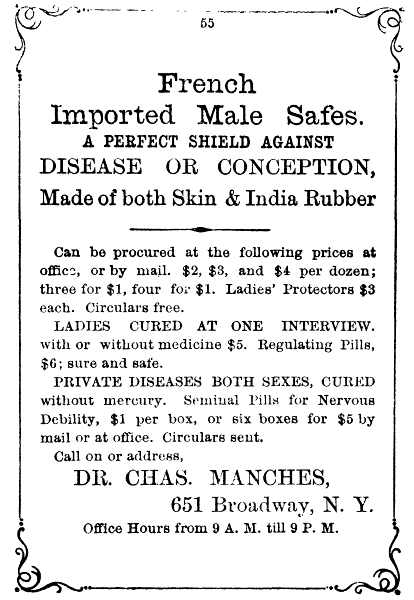


PS Roe v. Wade’s holding is based on the due process clause of the 14th amendment, which has been interpreted to require the states to respect most of the explicit and implicit rights in the bill of rights. In the case of Roe, this is the right to privacy – that states cannot insinuate themselves into such personal decisions made by a woman in consultation with her doctor.
Prior to the 1920s, the states were NOT bound by the bill of rights – in state court, you had no constitutional right against self-incrimination, privacy, counsel, speech, etc. This changed primarily during the 1960s, and today states are bound by most (not all) of the rights specified or implied in the Bill of Rights.
 Carlton Thurman's Liberal Field Guide